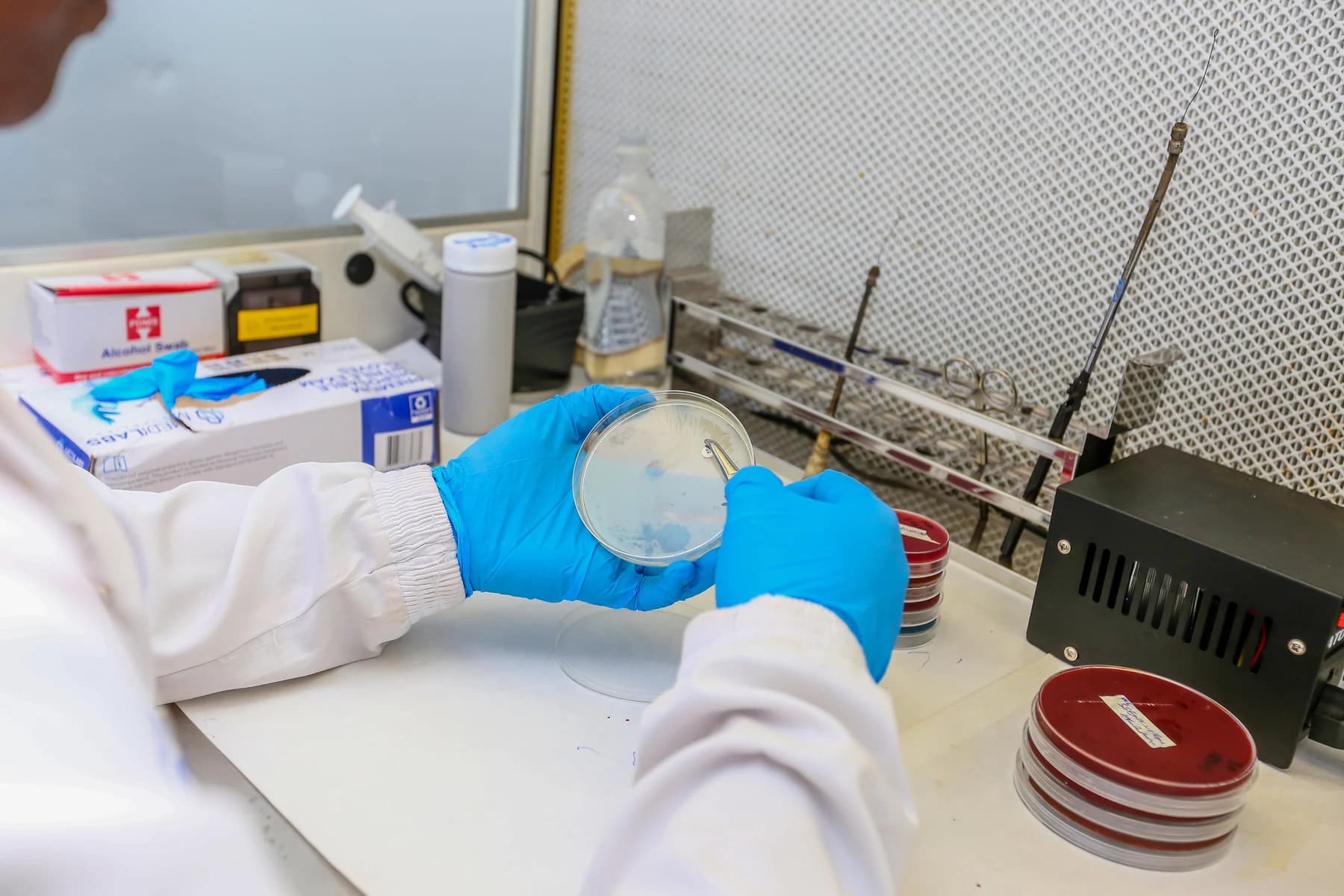
Timothy Nkwasibwe / Pexels · Pexels License · Image source
Meaningful innovation matters alongside new candidates
WHO’s report dated 2 October 2025 assesses antibacterial development data through 15 February 2025. It considers innovation through criteria such as a new target, mechanism, drug class or absence of known cross-resistance. Proposing many molecules therefore does not, by itself, address an unmet clinical need.
Research: looking behind a model’s recommendation
Published online on 20 December 2023, the study by Wong and colleagues used experimental data from 39,312 compounds to predict antibacterial activity and cell toxicity for more than 12 million compounds. Its explainable approach identified molecular substructures associated with predictions. Researchers experimentally tested 283 compounds and reported that one structural class reduced bacterial burden in mouse models of MRSA infection. This is preclinical evidence.
What do the experimental results establish?
MIT’s research report describes using models of toxicity in three human cell types to narrow the candidates. It presents detailed chemical and clinical evaluation as further work. Low toxicity in a cell experiment cannot establish a safe human dose or safety across organs; a model explanation cannot replace experimental verification.
Clinical use and authorisation are separate stages
FDA explains that preclinical research does not replace studies in people. Clinical trials need a protocol specifying participants, dose, duration, comparisons and assessments. This US development framework is not authorisation for an individual antibiotic. The research discussed here should not be used to conclude that a candidate is currently authorised or suitable for use in patients.
Editorial interpretation: keep three lines of evidence
Record separately which candidates AI selected, what laboratory experiments measured and which outcomes have been studied in people. A model explanation can generate a research question; it does not alone establish that the explanation is correct, generalises to other bacteria or predicts patient benefit. This is a guide to evaluating past research, not personal antibiotic advice or an effectiveness claim for RAI products.
Sources
- WHO — Analysis of antibacterial agents in clinical and preclinical development: overview and analysis 2025 ↗
Accessed: 2026-10-12 - Wong et al. — Discovery of a structural class of antibiotics with explainable deep learning (Nature; published online 20 December 2023), MIT repository ↗
Accessed: 2026-10-12 - MIT News — Using AI, MIT researchers identify a new class of antibiotic candidates (20 December 2023) ↗
Accessed: 2026-10-12 - FDA — Step 3: Clinical Research ↗
Accessed: 2026-10-12
This article is for education and information. Referencing an organization does not imply its endorsement of RAI PACS Pro. This is not a claim of clinical effectiveness for a product or model.