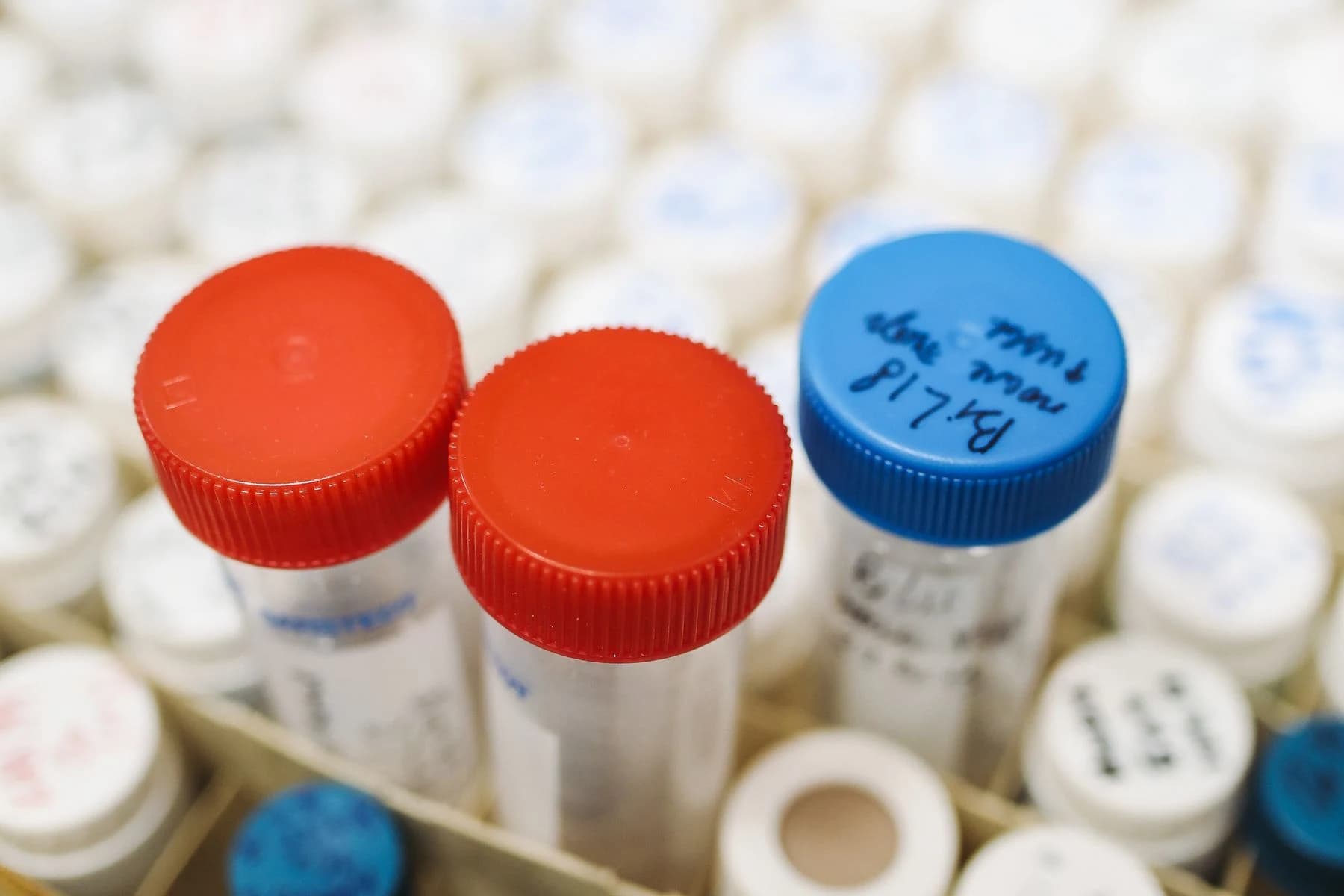
Polina Tankilevitch / Pexels · Pexels License · Image source
AI model forecasts disease risk over a decade in advance
EMBL-EBI · · Source
EMBL-EBI’s short English-language video about the Delphi research. This is a 2025 research announcement, not an individual diagnosis or authorization for clinical use.
Opening this video connects to YouTube and may share device information with the provider. The privacy-enhanced player is used; cookies may be used during playback. Playback does not start automatically.
Data preparation: establishing a shared language
The NIH All of Us programme brings together surveys, electronic health records, biosamples and other measurements. Health records are standardized using the OMOP common data model, then cleaned and processed to protect privacy. Individual-level data are analysed within the secure Researcher Workbench. This methods description is not a study demonstrating an AI model’s clinical performance; it explains how research data are prepared.
A research example: patterns of disease over time
The Delphi-2M study published in Nature in 2025 presented a model trained on records from 402,799 UK Biobank participants. External testing used records from approximately 1.93 million Danish individuals. The model uses the sequence and timing of diagnoses to model risk across more than 1,000 diseases. This is an evaluation using historical records, not a randomized clinical trial of treatment benefit. A 12 November 2025 correction fixes a typographical sign error in a methods equation.
Clinical use and regulatory authorization are separate questions
EMBL-EBI’s 17 September 2025 announcement describes the model as a proof of concept not ready for direct clinical use. Its outputs express probabilities, not certain future events. The announcement also identifies limitations such as underrepresentation of age and ethnic groups. A research paper or institutional news release does not substitute for regulatory authorization. The 2025 announcement discussed here should not be used to determine current authorization status.
Could sharing a model also expose participant data?
UK Biobank’s AI guidance asks researchers to assess whether a trained model can retrieve participant-level data or provide equivalent access. It also prohibits feeding these data into publicly available generative AI models. These are UK Biobank’s access and material-transfer conditions; they should not be assumed to be identical across biobanks. A model file is not automatically unrestricted simply because it contains no raw data table.
Our editorial interpretation: five questions at project start
Which event and time horizon is the research targeting? Which population do the data represent? Has the model been evaluated at another centre excluded from training? How closely do predicted risks match observed events? Who may receive the model or its outputs, and under which permissions? In our view, writing these questions down before model selection makes a biobank AI project easier to assess. This educational article does not provide an individual risk calculation or treatment advice.
Sources
- NIH All of Us Research Hub — Data Methods ↗
Accessed: 2026-10-06 - Shmatko et al. — Learning the natural history of human disease with generative transformers (Nature, 2025) ↗
Accessed: 2026-10-06 - Shmatko et al. — Author Correction: Learning the natural history of human disease with generative transformers (12 November 2025) ↗
Accessed: 2026-10-06 - EMBL-EBI — AI model forecasts disease risk decades in advance (17 September 2025) ↗
Accessed: 2026-10-06 - UK Biobank — Use of Artificial Intelligence (AI) applications and models ↗
Accessed: 2026-10-06
This article is for education and information. Referencing an organization does not imply its endorsement of RAI PACS Pro. This is not a claim of clinical effectiveness for a product or model.