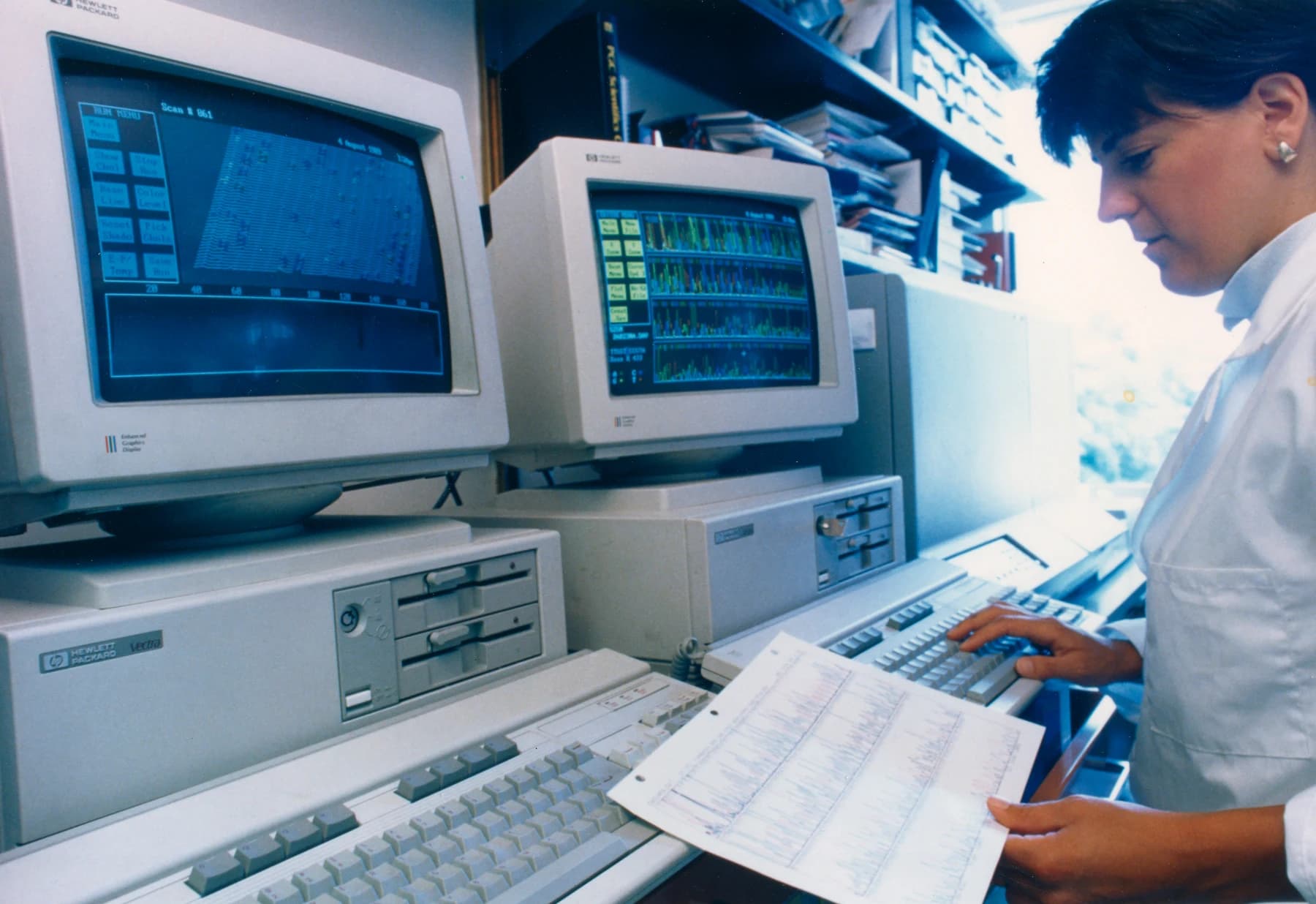
National Human Genome Research Institute (NHGRI) · Public domain · Image source
Predicting the effect of a variant
A missense variant changes an amino acid in a protein. EMBL-EBI explains that AlphaMissense uses related protein sequences and structural context to estimate pathogenicity. It does not predict a specific disease or every biophysical consequence of a change. This distinction helps clarify which question the displayed score actually answers.
Research: what does a large catalogue establish?
In its 19 September 2023 announcement, Google DeepMind described predictions for 71 million possible missense variants. A threshold yielding 90% precision on a database of known disease variants classified 89% of variants. These are research evaluation measures, not a promise of equivalent diagnostic performance or clinical benefit in every patient.
Calibrating the strength of evidence
Pejaver and colleagues’ 2022 study assessed thirteen computational tools using independent datasets and calculated thresholds linking scores to PP3/BP4 evidence strengths. Some tools reached moderate or strong evidence levels at particular thresholds, but performance varied. The study predates AlphaMissense: its thresholds should not simply be transferred to that model. A large numerical score does not establish its evidential strength by itself.
Access to a resource is not clinical authorisation
EMBL-EBI’s 2024 integration made predictions accessible in Ensembl, UniProt and other research resources. DeepMind states that its predictions were not designed for direct clinical use and should be interpreted alongside other evidence. These sources describe access to research data; they do not grant regulatory authorisation to a particular clinical product.
Editorial interpretation: ask three questions
Which variant types were evaluated? What data calibrated the threshold? How is the result considered alongside independent laboratory and clinical evidence? Recording the tool version and remaining uncertainty can help prevent a new prediction being conveyed as a definitive diagnosis. This educational article is not an individual genetic-test interpretation or an effectiveness claim for RAI products.
Sources
- EMBL-EBI — AlphaMissense data integrated into Ensembl, UniProt, DECIPHER and AlphaFold DB (21 May 2024; updated 3 June 2024) ↗
Accessed: 2026-10-13 - Google DeepMind — A catalogue of genetic mutations to help pinpoint the cause of diseases (19 September 2023) ↗
Accessed: 2026-10-13 - Pejaver et al. — Calibration of computational tools for missense variant pathogenicity classification and ClinGen recommendations for PP3/BP4 criteria (AJHG, 2022) ↗
Accessed: 2026-10-13
This article is for education and information. Referencing an organization does not imply its endorsement of RAI PACS Pro. This is not a claim of clinical effectiveness for a product or model.