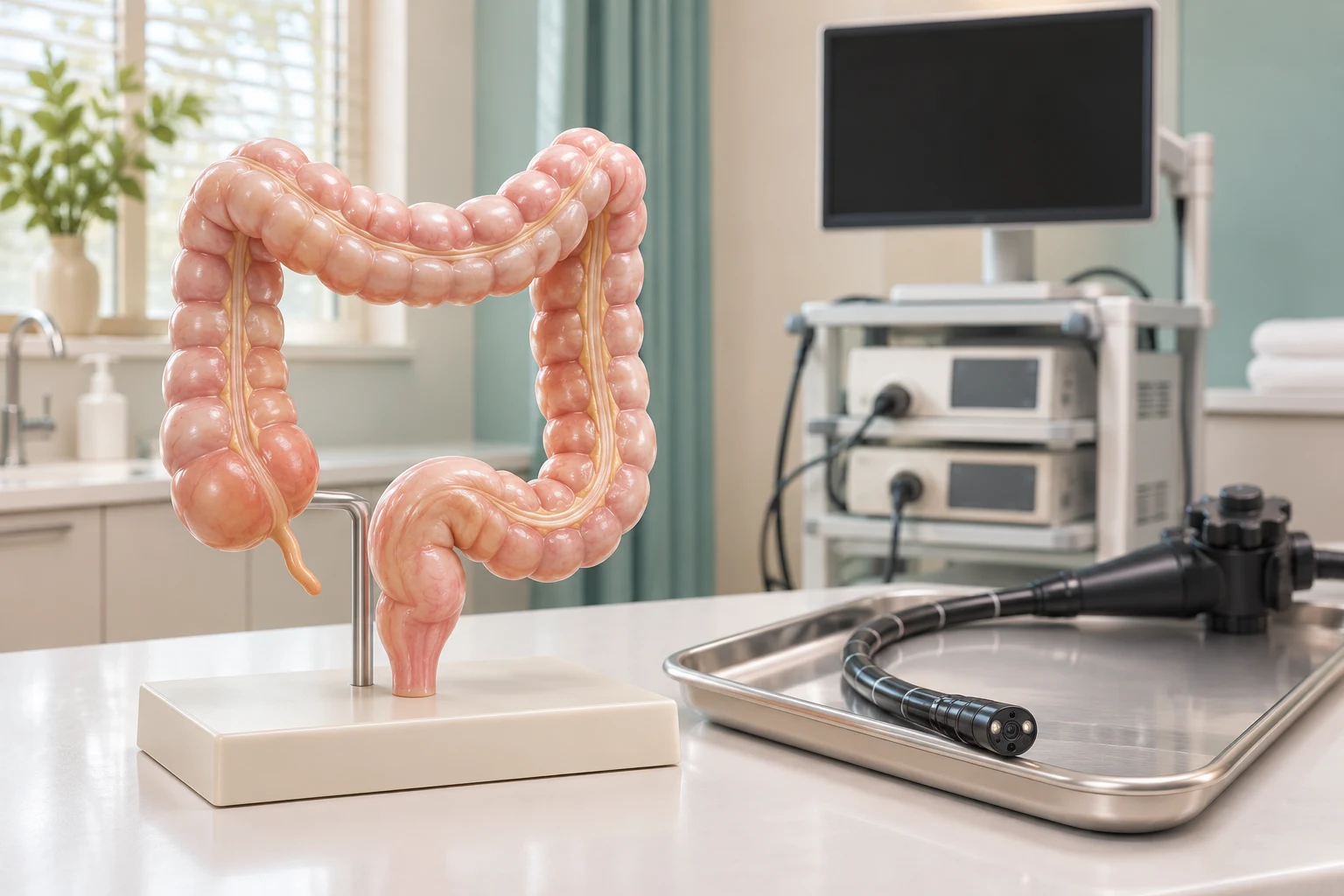
Mayo Clinic Minute: AI advances help care teams find hard-to-see colon polyps
Mayo Clinic · · Source
This English-language Mayo Clinic news video, published on 18 March 2026, describes AI-enhanced imaging for hard-to-see polyps. General screening messages reflect a US context; the video alone does not establish long-term cancer or mortality outcomes for CADe and is not personal screening advice.
Opening this video connects to YouTube and may share device information with the provider. The privacy-enhanced player is used; cookies may be used during playback. Playback does not start automatically.
What does CADe do?
CADe flags areas in the endoscopy video for closer assessment by the physician. The FDA’s 2021 GI Genius announcement states that the device does not classify lesions, provide a pathological diagnosis or replace tissue sampling. An alert is not a definitive polyp or cancer diagnosis; assessment and management remain the physician’s responsibility.
Why is adenoma detection a surrogate outcome?
Adenoma detection rate (ADR) is the proportion of colonoscopies in which at least one adenoma is found. AGA acknowledges evidence that CADe improves ADR while treating it as a surrogate outcome. ESGE also explains that finding more small adenomas and non-neoplastic polyps is distinct from finding clinically important lesions and establishing long-term cancer outcomes.
Why do AGA and ESGE differ?
The AGA guidance page dated 20 March 2025 makes no recommendation for or against CADe-assisted colonoscopy in adults, citing very low certainty for critical long-term outcomes. ESGE’s 2025 statement offers a weak recommendation in favor for people already choosing colonoscopy for screening or polyp surveillance. This is not a strong consensus: uncertainty, potential benefits and the burden of additional procedures are weighed differently.
What does regulatory authorization cover?
The FDA’s 9 April 2021 marketing authorization for GI Genius concerns a specific device and its defined assistive detection use. It is not a blanket authorization for every CADe product, later software versions or other countries. Nor should that decision alone be read as demonstrating a long-term reduction in colorectal cancer mortality.
How should an implementation report be assessed?
As an editorial appraisal, read the device and version together with the population, comparator and measured outcome. Detected lesions, pathology-confirmed findings and long-term outcomes should be reported separately. AGA identifies evidence gaps involving different clinical settings, important polyp types, resource use and patient-important outcomes. This framework is not personal screening or treatment advice.
Sources
- FDA Authorizes Marketing of First Device that Uses Artificial Intelligence to Help Detect Potential Signs of Colon Cancer ↗
Accessed: 2026-11-09 - Use of computer-aided detection systems (CADe) in colonoscopy ↗
Accessed: 2026-11-09 - Use of computer-assisted detection (CADe) colonoscopy in colorectal cancer screening and surveillance: European Society of Gastrointestinal Endoscopy (ESGE) Position Statement ↗
Accessed: 2026-11-09
This article is for education and information. Referencing an organization does not imply its endorsement of RAI Health Pro. This is not a claim of clinical effectiveness for a product or model.