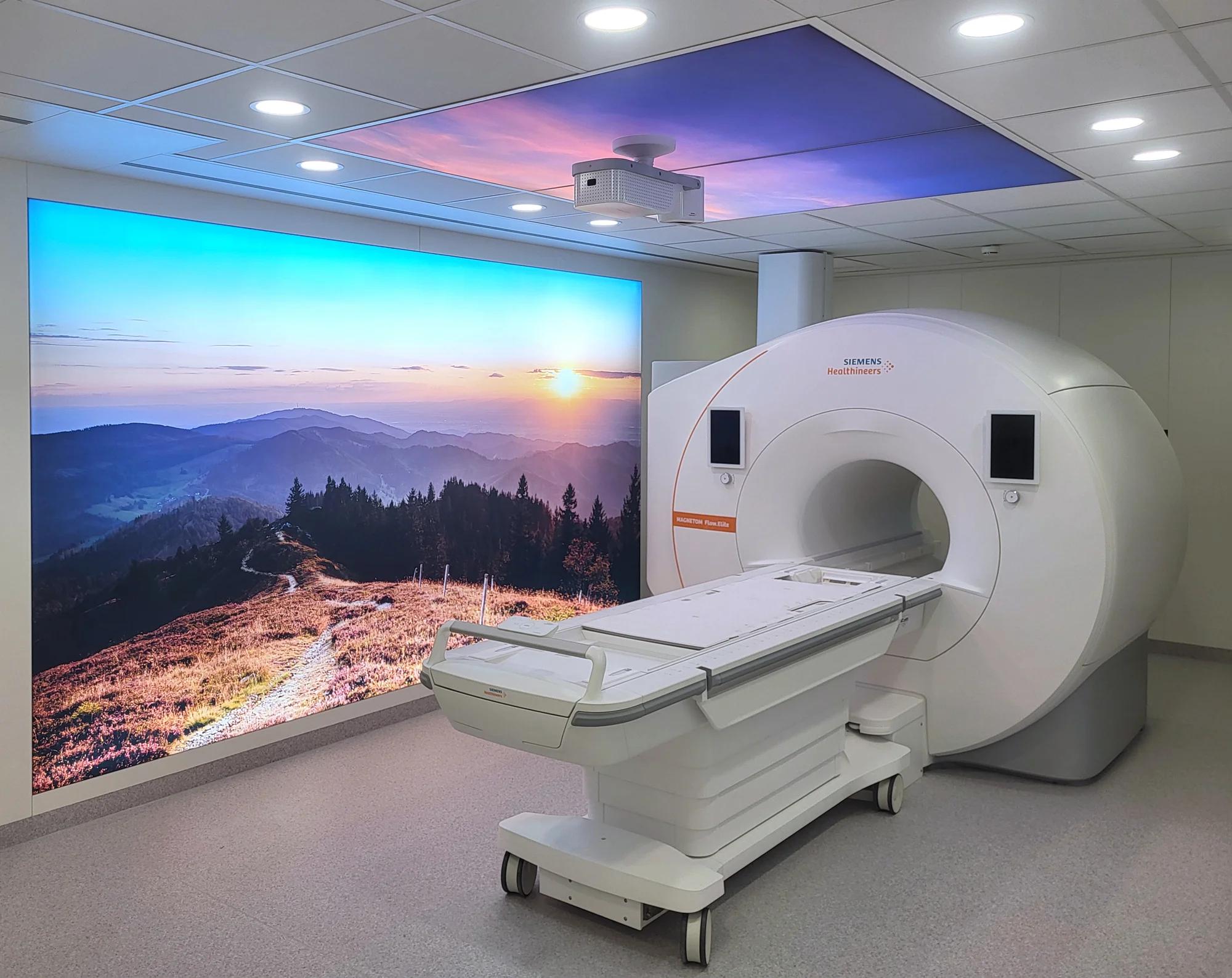
Artificial Intelligence For MRI Helps Overcome Backlog of Exams Due to COVID
Imaging Technology News · · Source
In this English-language interview from 2021, HSS radiologist Darryl B. Sneag discusses his clinical experience with MRI reconstruction. It concerns a different implementation from the 2023 knee MRI study below and is not an evaluation of RAI products.
Opening this video loads Imaging Technology News’ Brightcove player. Your IP address and device information may be shared with the provider, which may use cookies. Playback does not start automatically.
Research scope: turning measurements into images
MRI reconstruction forms images from measured signals; it is a different task from drafting a report about an existing image. NYU’s fastMRI initiative supplies raw k-space data and images for acceleration research. De-identification does not remove usage conditions: the sharing agreement defines research and education uses and excludes clinical use. Access to a dataset therefore does not establish that a model developed with it has been validated for use in patients.
Clinical research: what did the knee study show?
The prospective study published by Johnson and colleagues in 2023 evaluated knee MRI in 170 participants with six musculoskeletal radiologists. In the tested 3-tesla protocol, deep learning reconstruction enabled nearly twofold shorter acquisition with comparable abnormality detection; readers rated image quality more highly. This supports a specific protocol. Our editorial interpretation: the result should not be generalized to every anatomy, scanner or patient group, or presented as direct evidence of improved patient outcomes.
Experimental evidence: is a pleasing image enough?
Antun and colleagues’ 2020 study demonstrated instability experimentally in the deep learning reconstruction systems examined. Small input changes could produce substantial artifacts, and some small structural changes were absent from the output. These stress tests do not establish that every contemporary system has the same problem or quantify patient harm in routine practice. Their contribution is to show why evaluation should examine preservation of small structures and robustness to changing conditions alongside overall image quality.
Regulatory scope: which device and intended use?
The FDA list of AI-enabled medical devices links to public documents for devices authorized for marketing in the United States and states that it is not comprehensive. A research publication and a product’s regulatory status answer different questions. Assessment should use the particular device’s intended use and authorization documents. An entry for one device is not blanket authorization for similar models; US status alone does not establish the conditions for use in another country.
Editorial assessment: questions to put alongside speed
We suggest including these questions in a hospital evaluation plan: Which anatomy and acquisition protocol were compared? How were small findings, artifacts and repeat examinations tracked? Which checks will be repeated after a software version changes? Time saved during acquisition should also be measured across the wider workflow. These are editorial evaluation suggestions; this article provides no evidence of clinical performance or regulatory conformity for RAI products.
Sources
- NYU Langone Health — fastMRI Dataset and Dataset Sharing Agreement ↗
Accessed: 2026-10-25 - Johnson et al. — Deep Learning Reconstruction Enables Prospectively Accelerated Clinical Knee MRI (Radiology, 2023) ↗
Accessed: 2026-10-25 - Antun et al. — On instabilities of deep learning in image reconstruction and the potential costs of AI (PNAS, 2020) ↗
Accessed: 2026-10-25 - FDA — List of Artificial Intelligence-Enabled Medical Devices ↗
Accessed: 2026-10-25
This article is for education and information. Referencing an organization does not imply its endorsement of RAI Health Pro. This is not a claim of clinical effectiveness for a product or model.