Applications of Artificial Intelligence in Echocardiography | Akhil Narang, MD
Minneapolis Heart Institute Foundation · · Source
This English-language educational presentation from the Minneapolis Heart Institute Foundation, published on 10 October 2022, discusses AI applications in echocardiography. It predates the 2023 trial and does not report that trial’s results.
Opening this video connects to YouTube and may share device information with the provider. The privacy-enhanced player is used; cookies may be used during playback. Playback does not start automatically.
What does acquisition guidance do?
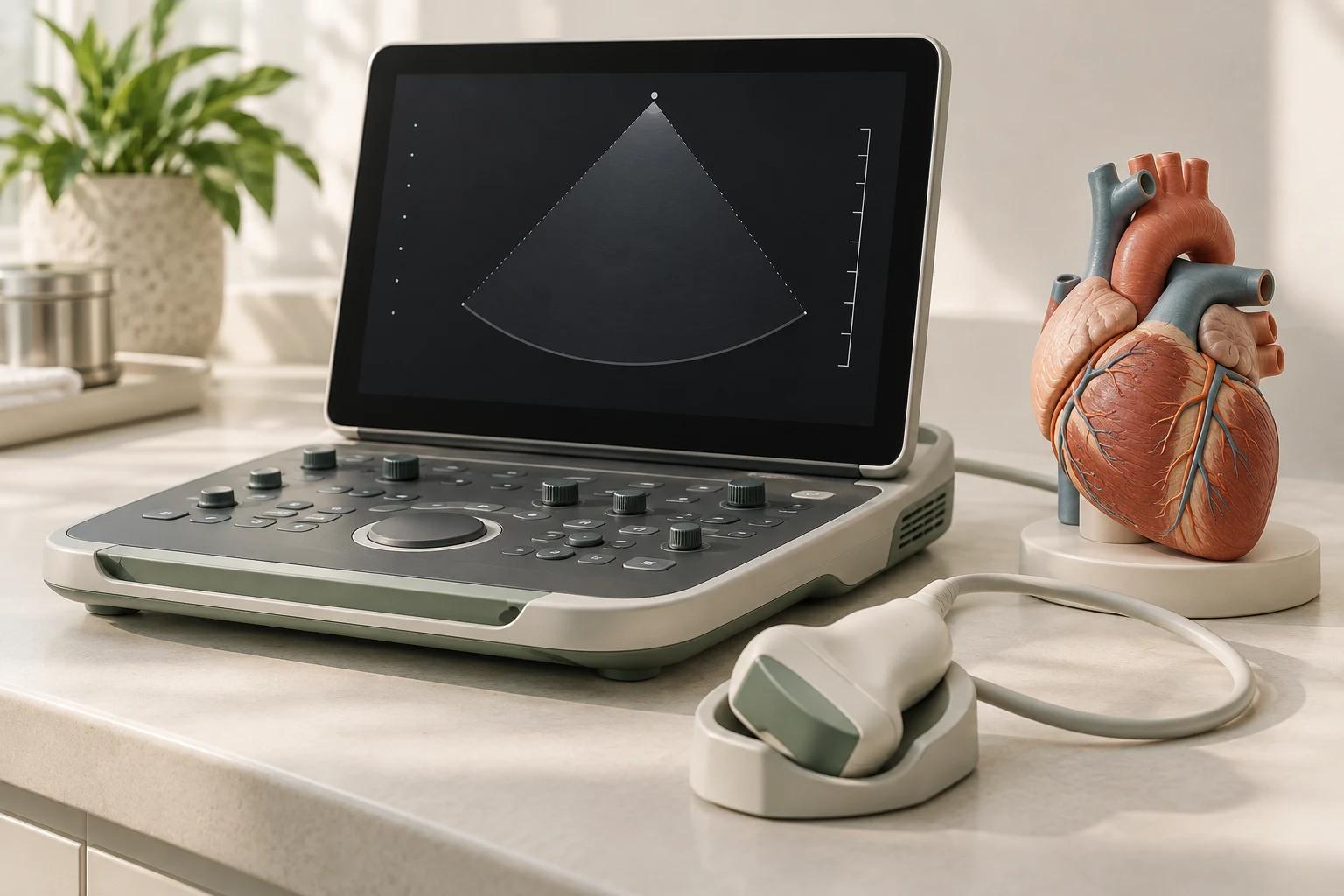
Probe position and angle affect which cardiac structures are visible on echocardiography. Acquisition AI can suggest movements, provide quality feedback and help capture a suitable view. Calculating left ventricular ejection fraction (LVEF), the fraction of the left ventricle’s end-diastolic blood volume ejected with each contraction, from acquired images is a separate analysis task.
What did the 2021 study show about image quality?
In a prospective study at two centers, 8 nurses with no previous ultrasound experience received study training and scanned 240 adults using AI guidance. In blinded expert review, images were adequate to assess left ventricular size and function in 98.8% of cases. This is not diagnostic accuracy for all heart diseases. The study assessed a limited examination; Caption Health and the IDP Foundation funded it, and the company’s research involvement was disclosed.
What did the 2023 randomized trial measure?
A separate trial randomized 3,495 previously acquired echocardiographic studies to an initial LVEF assessment by AI or a sonographer. Cardiologists changed the initial value by more than 5 percentage points in 16.8% of the AI group and 27.2% of the sonographer group. Cardiologists made the final assessment. This is an interpretation-workflow outcome; the single-center trial was not designed to demonstrate long-term patient benefit and did not test new image acquisition.
What is the scope of regulatory authorization?
The FDA’s DEN190040 review of Caption Guidance concerns acquisition of specified two-dimensional transthoracic cardiac ultrasound views in adults. It requires qualified medical professionals to interpret images and check their adequacy. This product- and use-specific record is not authorization for every ultrasound AI system or for RAI products.
What should an institution evaluate separately before adoption?
Our editorial assessment: local evaluation should separately track supported devices and patient groups, handling of inadequate images, measurement deviations and the expert review pathway. An apparently adequate image should not be equated with a correct comprehensive diagnosis or better patient outcomes. These studies do not establish clinical effectiveness for RAI products; they illustrate the need for training and local validation.
Sources
- Narang et al. — Utility of a Deep-Learning Algorithm to Guide Novices to Acquire Echocardiograms for Limited Diagnostic Use (JAMA Cardiology, 2021) ↗
Accessed: 2026-11-01 - He et al. — Blinded, randomized trial of sonographer versus AI cardiac function assessment (Nature, 2023) ↗
Accessed: 2026-11-01 - FDA — De Novo Classification Request for Caption Guidance (DEN190040) ↗
Accessed: 2026-11-01
This article is for education and information. Referencing an organization does not imply its endorsement of RAI Health Pro. This is not a claim of clinical effectiveness for a product or model.